

On a night of historic progressive wins, why did Colorado also pass two anti-trans ballot measures?
By Cecelia Thorn
Boulder Weekly
On election night, the nationwide blue wave included Colorado, which flipped seats in longtime Republican-held districts and even passed the most progressive fiscal policy our state has ever seen.
At the same time, Colorado also passed two ballot measures restricting the rights of transgender people.
This combination has been puzzling to both casual observers and seasoned politicos alike.
Ian Silverii is a longtime strategist who was the General Consultant on the Yes on 87 campaign, which has been celebrating Colorado passing the progressive tax measure despite the millions spent by dark money groups trying to defeat it. A few days after the election, Silverii spoke to us while he was building out virtual maps, trying to analyze these complicated results.
“The vibes are like… how does Phil Weiser win 61 percent of the vote, and the trans measures pass on the same ballot? What makeup of the electorate does that?”
He was crunching the numbers while thinking out loud. He considered the difference between these two measures: Proposition 134 prohibits kids from playing on school sports teams that don’t match their biological sex, while Proposition 135 prohibits minors from getting gender-affirming surgeries.
“The sports ban got around 8,000 more yes votes than the surgery ban,” he said. “But the surgery one had 3,000 more total votes.”
But the fact that people didn’t lump their anti-trans measures together wasn’t even the most surprising thing about it.
“The sports ban won basically every county that’s not objectively liberal,” he said. Boulder was one of the few counties to vote against it. “But if you look at the map of Amendment 87 versus the map of Proposition 134, it’s like looking at two different universes.”
Amendment 87, which is now ushering in the state’s new graduated tax system, is considered very progressive. It was too progressive for the leaders of Colorado’s own Democratic Party: Governor Jared Polis railed against it, and Governor-elect Phil Weiser came out against it just days before the election, shocking many of his own supporters, who had fought to get it on the ballot.
(Full disclosure: I collected signatures as a volunteer to help get Amendment 87 on the ballot.)
Colorado passed Amendment 87 anyway. Many voters noticed that Governor Polis may have been acting in his own best interest, as Amendment 87 will raise taxes on billionaires and centimillionaires like himself.
But even in the counties where Amendment 87 won, progressive voters did not vote as a monolith.
“Look at Summit County, for example,” said Silverii, who was still crunching the numbers. “On Amendment 87, it’s 58 percent yes, and then you look at the no votes on 134 [the sports ban], it’s 54… that’s a four-point difference.”
The difference was even starker on the Eastern Plains, in the district that unseated Republican Representative Lauren Boebert.
“It’s objectively a blue tsunami,” Silverii said, as he reviewed the regional data. “But [tons] of people who voted for Laubacher also voted for the sports ban… It’s not reliable to say, if a Democrat wins a congressional race, then progressive ballot preferences will carry the day.”
These divergences caused the year’s most progressive measures to pass alongside some of the least.
The sports ban is projected to have a bigger impact than the surgery ban, because gender-affirming surgeries on minors are already very rare.
Colorado hospitals have told other news outlets they don’t perform these surgeries on children.
“Very few minors get surgeries,” says Li Brookens, the director of Umbrella Collective, a LGBTQ-focused mental health practice in Boulder. “[But] trans youth are thriving in sports, and sports had become a safe space.”
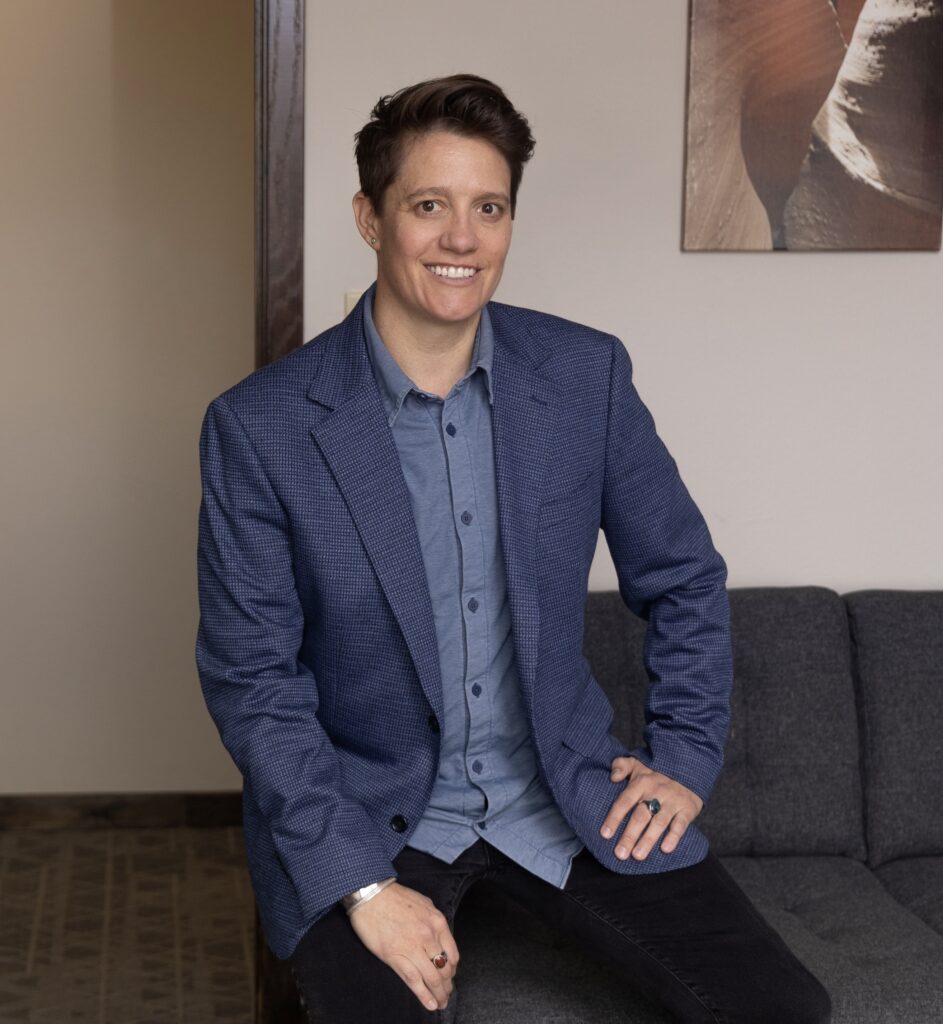
These sports can serve a critical role in their mental health, says Brookens, who uses they/them pronouns. “To have a team, a band of people rallying around them, saying yes, you belong here… it’s about community, belonging.”
That sense of belonging is especially critical for trans youth, who already face higher risks of negative mental health outcomes, they explain.
“Trans people are more likely to not use positive coping resources,” says Brookens, “Trans youth have a higher risk of falling into substance use and abuse and suicidality.”
And when trans youth choose to isolate themselves due to a perceived lack of safety, Brookens explains, these risk factors can skyrocket.
And the risks may affect more than just transgender youth, says Sam Armstrong-Zickefoose, a nonbinary Colorado musician who has worked in public schools.
“There’s no appeals process written into the measure,” they said. (Armstrong-Zickefoose also uses they/them pronouns.) And it’s written so broadly… Like anyone who’s too tall or too fast, or just not traditionally feminine, could have to prove that they’re a girl, which is super invasive. So it’s not just making trans kids less safe, it’s making all kids less safe.”
But some parents are happy about the new measures. Even some parents whose kids identify as transgender.
Gene Maine is a father of three in Erie.
“My son from my previous marriage has always been on the effeminate side,” he says. So he assumed his son was gay. “Which is fine with me,” he adds. “[But] my ex-wife had a different opinion. She basically has been drip, drip, dripping him that: No, no, no. You're a girl. You're not gay. And by about the age of 12, he came out to me and said, well, Dad, I think I'm a girl.”
Maine says that’s when he started researching.
“So I did the research on all the transgender stuff, you know, found out how much of it is activism, how little of it is science. You know, how much of it is status for the parents to have a trans child.”
So Maine pushed back on his child’s announcement.
“I said… you don't fit the profile of, you know, a trans child. You're an extrovert. You have tons of friends. You're a great student. You're not on the spectrum. But you do fit the profile of a gay man.”
But when Maine’s ex-wife won in court, the child was able to start puberty blockers.
Maine believes this is a misguided mistake. But everyone I spoke to in the nonbinary and mental health communities has emphasized that no one is taking puberty blockers casually.
Virginia Sanford, another licensed therapist at Umbrella Collective, explained how it works.
“It’s actually a rigorous process that involves working with a mental health professional and a doctor,” she says, “to determine whether this is a necessary step for a child to take to alleviate significant mental health concerns related to gender, such as severe depression, anxiety, suicidal ideation, or self-harm.”
But Gene Maine says he’s spending his retirement savings fighting against these medical steps. He emphasizes that he has his child’s best interests at heart.
“I don't have a higher calling than protecting my children,” he says. “That's always my top priority.”
Maine says puberty blockers may have negative consequences that are not yet fully understood.
I asked him how this was connected to school sports, because he had supported both Proposition 134 and 135.
“It’s about protecting girls that want to excel in sports,” he said. “[Girls] that want to get college scholarships… they just cannot compete with men.”
This issue has not affected his own child, who is more interested in theatre. And none of Maine’s children go to public school.
But Erin Lee, the founder of Protect Kids Colorado, which sponsored both measures, says the problem is real. Her kid’s school’s volleyball team had to compete against a biological male last year — or forfeit their game.
“Imagine being a teenage girl forced to make that decision,” she wrote to us in an email.
Erin Lee has been vocal about her own family’s journey when her daughter came out as trans after hearing about different identities at a school club. Lee says she and her husband were “vilified” for not accepting their child’s new identity. Lee now advocates against sending children to public school, based on her own experience.
She says the surgery problem is also very real, and she cites a database that lists 60 sex-change surgeries being performed on minors over a four-year period in Colorado.
But multiple news outlets had already questioned the legitimacy of this database, before Lee sent us a link to it.
Gene Maine, the father of three in Erie, said he supported Proposition 135 just in case doctors do decide to start doing gender reassignment surgeries on minors in the future. He believes doctors might be inclined to do this for financial gain.
“It's a very, very lucrative business,” he said. “Because to trans an adult is hundreds of thousands of dollars in medical surgery, so that's very appealing to some of the medical professionals who are not of the scrupulous type.”
So passing Proposition 134 was “a good first step,” he said.
The idea that these measures are “a first step” is troubling to those in the queer and trans community.
“My thinking is like, since there are so few trans children in sports at that age, it’s more like a foot in the door to regulate trans people,” says Armstrong-Zickenfoose, who recalls similar fear-based messaging around different sexualities when they were growing up in Colorado Springs.
But Erin Lee says these new laws are critical to protecting children. She says she’s met many people who’ve undergone gender reassignment surgery and experienced serious regret over losing their reproductive futures.
But Li Brookens, who is nonbinary and works with trans people on a daily basis, disagrees.
“[That campaign] finds the voices of the few, but if you look at the detransitioner community overall… you hear that it's not connected to regret,” Brookens explains. “The detransitioner is like, I’m a sovereign human, I recognized the need for change within myself at that time.”
But this fluid approach to gender doesn’t work for everyone.
“There’s no gray area in saying ‘no boys in girls’ sports,’” Gene Maine says.
But advocates are calling on legislators and school districts to block the implementation of the sports ban, and Governor-elect Weiser has said he will look into it. This has enraged the pro-134 crowd, who are now repurposing the “No Kings” slogan to criticize the move by Weiser.
But regardless of how the measures are implemented, members of the community say damage has already been done.
“The messaging alone hurts our trans youth,” says Brookens, who has heard these concerns from their LGBTQ mental health clients. “Just by being a political scapegoat on the ballot for voters to decide upon.”
Political strategist Ian Silverii calls the scapegoating of trans people a “right-wing political project.”
“Unfortunately… it’s succeeding,” he says. “Even in a state like this, even in a year like this.“
Brookens and their clients and community are feeling the effects.
“It was like, there's a blue wave across the country, that’s great,” they say. “But come on, Colorado.”