

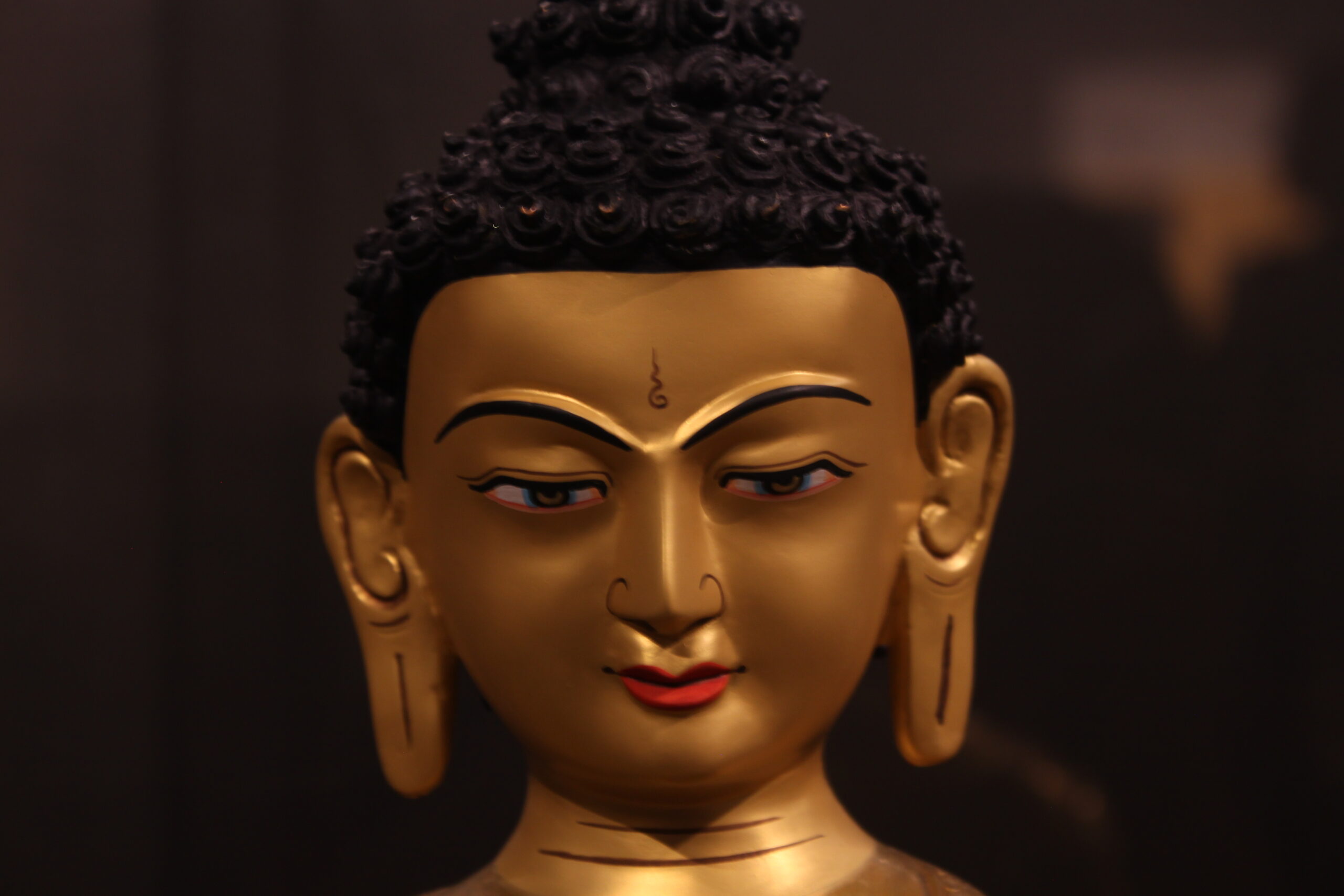
‘A Century of Collecting’ and ‘Heritage in Motion’ examine the objects, traditions and memories communities choose to carry forward.
By Emily Bernard
Boulder Weekly
The first thing visitors notice inside the Museum of Boulder is not a single object but a feeling.
A vintage gas pump rises from the gallery floor. Quilts unfold in intricate patterns nearby. Protest signs share space with mining tools, vintage clothing and artifacts spanning generations of Boulder history. Across the museum, a golden image of Ganesh catches the light, surrounded by textiles, artwork and family heirlooms that traveled thousands of miles before finding a home in Colorado.
Through Jan. 3, 2027, “A Century of Collecting: Stories from Our Vault” and “Heritage in Motion: Third Series” explore how communities preserve the stories, traditions and identities that shape them. One exhibition examines a century of artifacts documenting Boulder history. The other follows the traditions, memories and relationships Nepali families have carried across generations and continents.
Though strikingly different in appearance, both exhibitions ask the same question: What is worth saving?
A century of Boulder in objects
For curator Elizabeth Nosek, “A Century of Collecting” began with a question.
While the museum was celebrating its centennial two years ago, Nosek became curious about when the institution first began collecting history. Her search led to a January 1926 “Daily Camera” advertisement in which publisher A.A. Paddock asked Boulder residents to contribute photographs, documents and objects that could help tell their community's story.
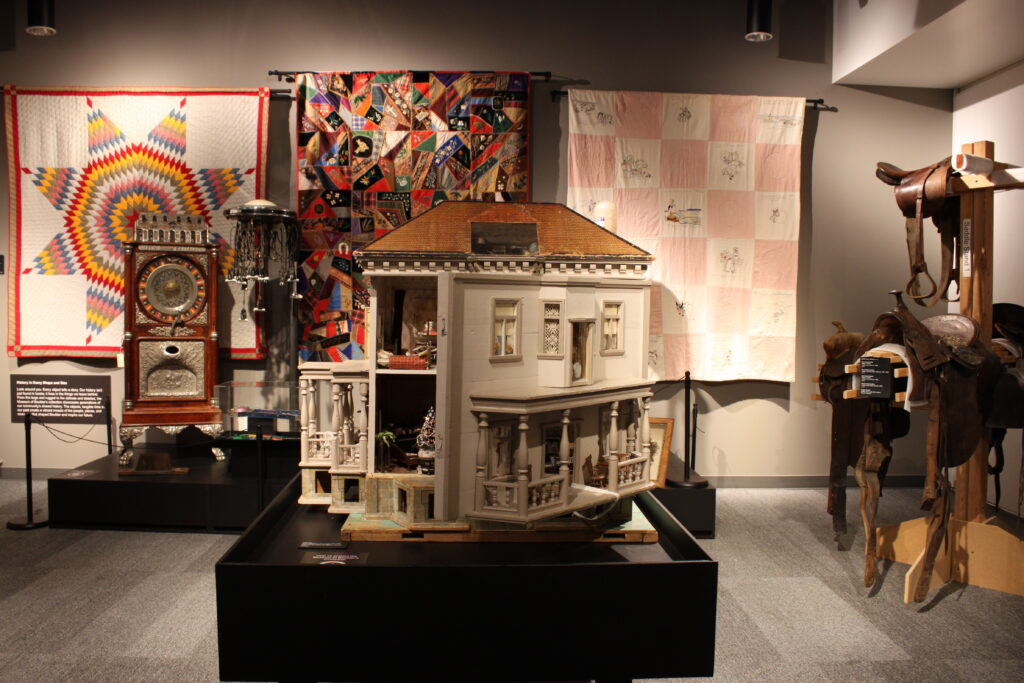
"A Century of Collecting" Photo: Dominic Rodriguez
That appeal became the foundation of a collection that now contains roughly 45,000 artifacts.
The first item remains unknown. The museum has moved seven times, and formal documentation did not begin until 1930. Nosek believes one of the earliest acquisitions may have been a flax-processing machine known as a hackle, though no surviving record confirms it.
A century later, more than 200 objects fill the gallery, many rarely displayed. Some commemorate major events. Others preserve ordinary lives. Together they reveal a Boulder that is broader, stranger and more complicated than popular memory often suggests.
A Tour de Trump cycling jersey recalls a moment when Boulder found itself connected to a national stage. Protest signs and pussy hats document political activism. Pieces from the nationally recognized Phyllis Plehaty Costume Collection trace changing fashions and social expectations. Quilts, household artifacts and mining tools preserve stories that might otherwise have disappeared.
Among the exhibition's most arresting pieces is a wall hanging once displayed in the Boulder Theater depicting a white woman as an Egyptian figure. The work, created by a man who had been convicted of murdering his wife, is a history that reflects Nosek's belief that museums must preserve difficult stories alongside celebrated ones.
"We don't just save the good history here; we save history that isn't a pretty story," Nosek said. "History is not all whipped cream and fairy tales. History is a work in progress."
Rather than presenting Boulder as a collection of accomplishments, the gallery embraces contradiction. Progress sits beside prejudice. Civic pride shares space with conflict. Public achievements exist alongside difficult chapters that still shape the present.
At the center of that approach is Nosek's belief that collections are held in public trust. The artifacts preserved in museum storage ultimately belong to the community whose lives they document.
After more than four decades in museums, she still speaks about objects with the enthusiasm of someone discovering them for the first time. Visitors encounter that same sense of discovery throughout the exhibition, where seemingly ordinary artifacts reveal unexpected stories.
One section, titled "Danger Inherent," explores another side of preservation.
Uranium glass glows beneath museum lights. A lead-glass goblet sits nearby. An asbestos fire extinguisher reminds visitors that some objects preserve dangers as well as memories. The display offers a glimpse into the care required to preserve the past safely.
"They still tell our story," Nosek said.
By the time visitors leave the gallery, Boulder emerges not as a fixed identity but as an ongoing conversation.
"Some are downright funny, and some are downright weird, and some are exceptionally beautiful," Nosek said. "But it's together that these objects tell the story of Boulder in a way a book and oral history cannot."
Carrying home across generations
If “A Century of Collecting” explores what communities leave behind, “Heritage in Motion: Third Series” explores what people carry with them.
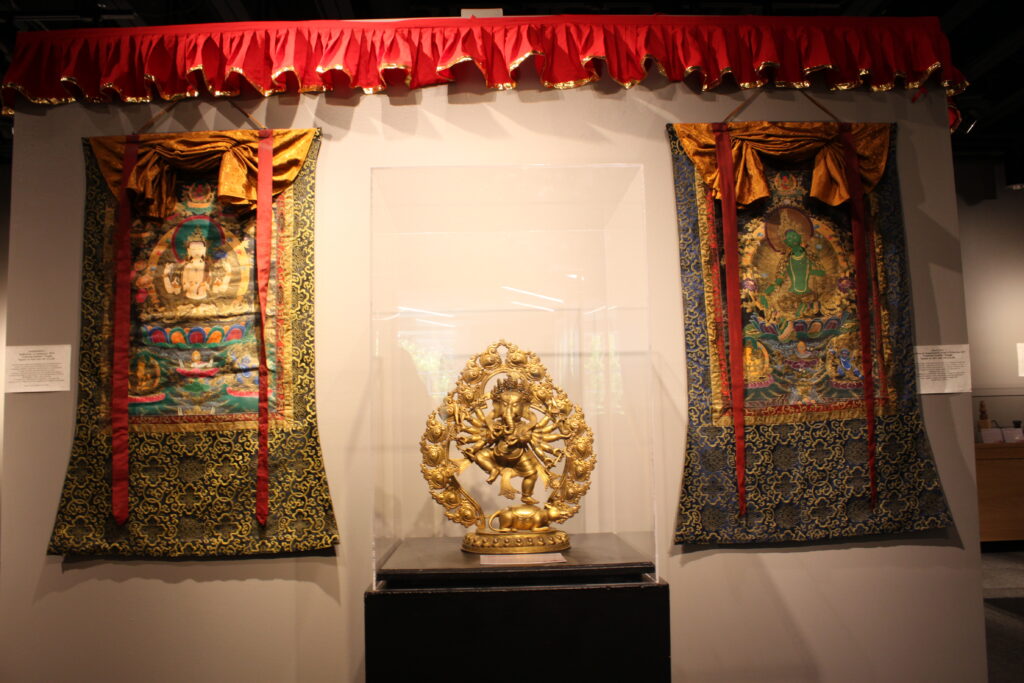
"Heritage in Motion" Photo: Dominic Rodriguez
Stepping into the exhibition feels like entering a different kind of archive.
Near the entrance, a luminous golden image of Ganesh immediately commands attention. Rich textiles introduce bursts of color. Artwork stretches across the walls. Ritual objects, family photographs and heirlooms guide visitors through the space.
Presented in partnership with the Colorado Nepalese Community and curated by Binisha Shrestha, the exhibition brings together artwork, textiles, ritual objects and personal narratives exploring Nepali identity and the evolving meaning of home.
Building on previous installations at the Aurora History Museum and Denver International Airport, the Boulder exhibition places particular emphasis on intergenerational storytelling and the experiences of Nepali families in Colorado.
Just days before the exhibition's opening reception, a catastrophic glacial flood struck northern Nepal. Organizers transformed what had been planned as a celebration into an evening of remembrance and solidarity, reinforcing the exhibition's themes of resilience, connection and community across distance.
For Shrestha, the project grew from a deeply personal question.
"How do we make sure our stories are not invisible?" she said.
As an immigrant from Nepal, she came to understand that belonging requires more than acceptance. People want to see their histories, traditions and families recognized in the places where they live.
A carved wooden window becomes a connection to generations of craftsmanship. Traditional garments trace journeys across continents. Sacred objects carry memory, identity and faith through time and distance. Contemporary artwork stands beside inherited artifacts, showing how culture evolves without losing its roots.
No single piece dominates the room. Instead, meaning builds through accumulation. Visitors move through stories of migration, family and identity, discovering how ordinary belongings become vessels for memory. The arrangement creates a sense of movement between Nepal and Colorado, past and present.
For Shrestha, migration is about far more than geography.
"We migrate with an invisible suitcase filled with language, food, faith, music, rituals, family memories and things our parents and grandparents taught us," she said.
That invisible suitcase appears throughout the gallery in family stories, artwork, recipes, traditions and objects preserved across decades.
"One thing I have learned through Colorado Nepalese Community is that culture survives through very ordinary acts of love," Shrestha said. "Preservation is not only about protecting old things. It is about keeping relationships, memories and knowledge alive."
By the end of both exhibitions, the relationship between them becomes clear.
One gallery preserves the objects a community leaves behind. The other preserves the traditions people carry forward. One looks to artifacts to understand history. The other explores how memory, culture and identity survive through people.
Sometimes that inheritance takes the form of a quilt stitched generations ago, a protest sign raised in a moment of upheaval or a fragile artifact protected in museum storage. Sometimes it survives in a family recipe; a story passed between generations or a tradition carried across an ocean.
Some inheritances are stitched into quilts, preserved in museum storage or displayed beneath glass. Others travel in the invisible suitcase Shrestha describes, carried through recipes, traditions, languages and family stories. Together, the exhibitions suggest that history survives not because it is preserved, but because each generation chooses to carry it forward.
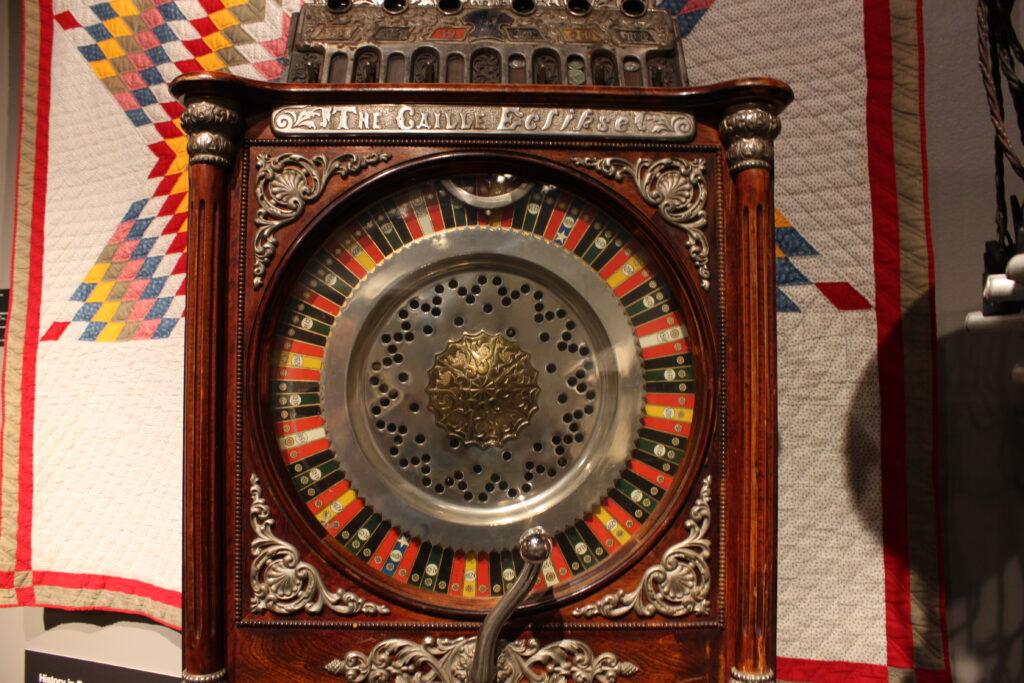
"A Century of Collecting" Photo: Dominic Rodriguez
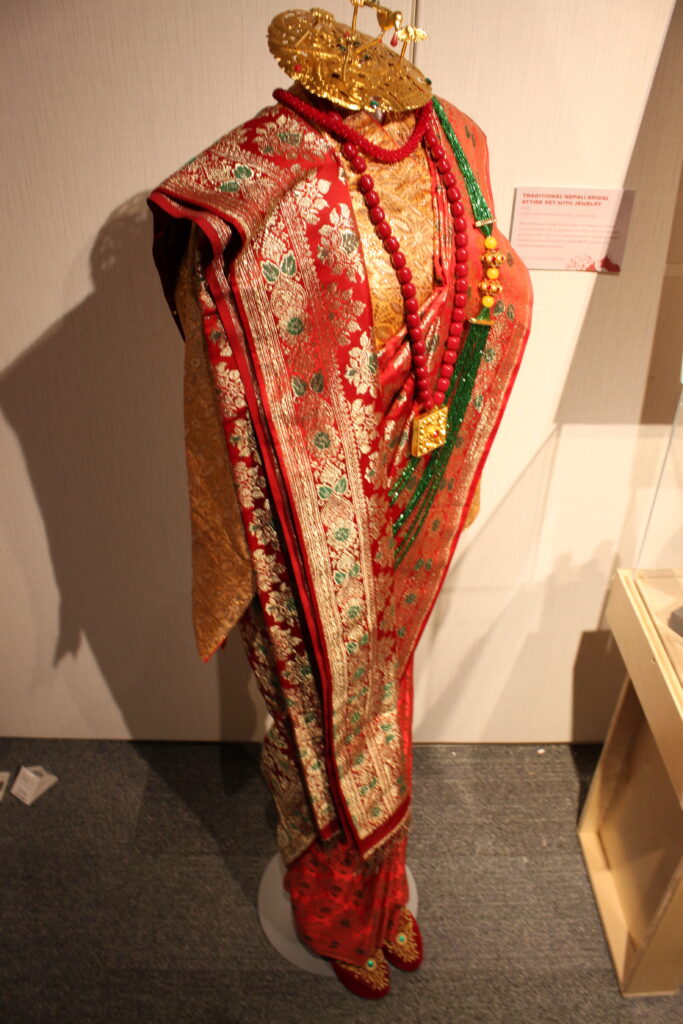
"Heritage in Motion" Photo: Dominic Rodriguez