

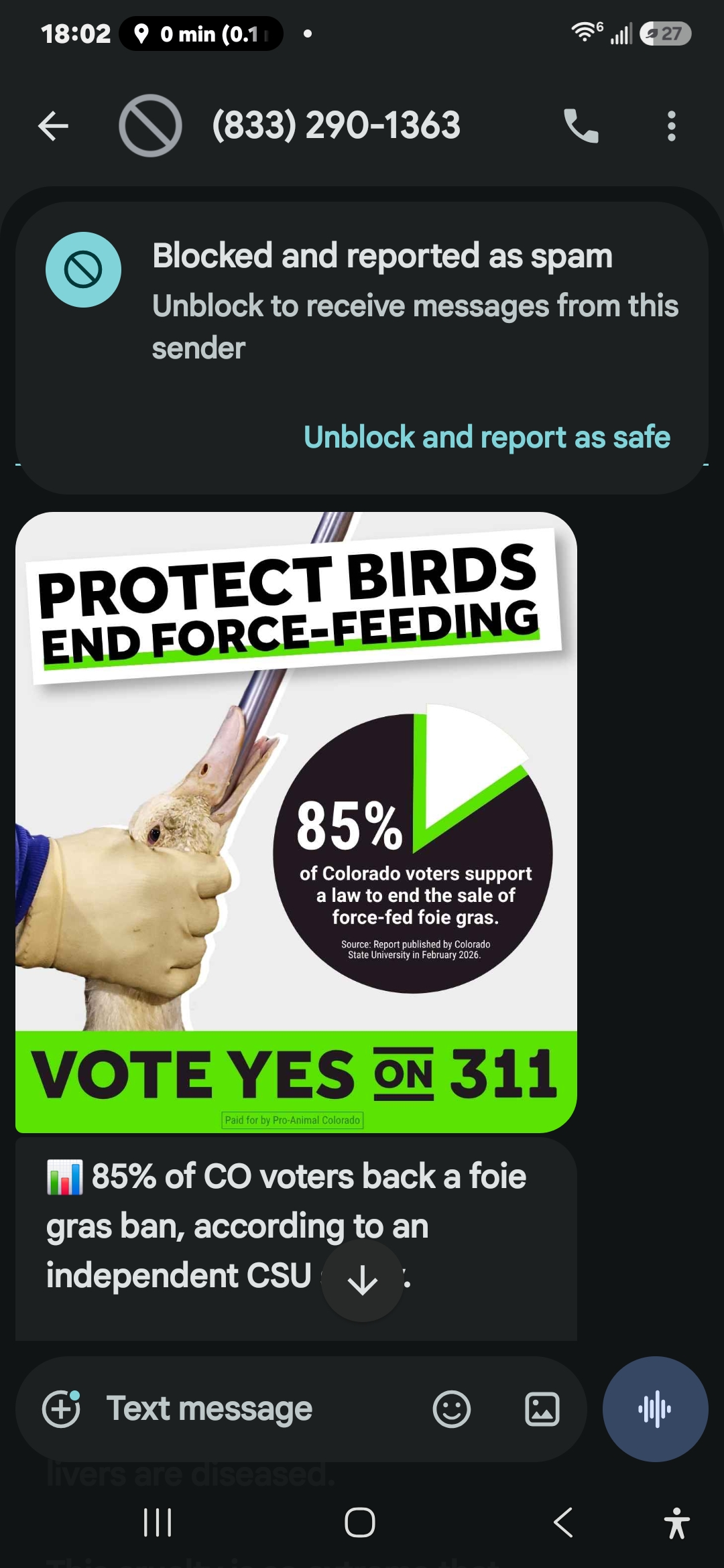
Political campaigns reach your phone through a chain of data brokers, texting vendors, telecom providers and campaign committees operating under a framework that verifies who sent the message, but not whether you wanted it.
By Emily Bernard
Boulder Weekly
The votes were counted, the results were in, and my phone was still buzzing. Another political text, another unrecognized number. I had blocked, reported and replied "STOP" to so many of these messages that the ritual had gone numb. My group chats were trading screenshots of the same thing, everyone asking the same question: how is this legal?
For decades, political advertising arrived in ways you could see or hear. A spot between the evening news and the weather. A mailer glossy enough to keep on the fridge or toss in the recycling. Then it moved onto the phone, into a device that never leaves your hand and rarely leaves your pocket.
Now it arrives on the nightstand, in the office, at dinner.
The answer to why it keeps arriving lies in a network of data brokers, texting vendors, telecom providers and campaign committees operating under a regulatory framework that treats many peer-to-peer political texts differently than automated robocalls. To understand why your phone won't stop, you have to look at how the system verifies the sender, while leaving the consent of the recipient largely unverified.
THE HUMAN CLICK AND THE P2P WORKAROUND
If a furniture store used an autodialer to blast you with texts, the Federal Communications Commission would step in. The Telephone Consumer Protection Act of 1991 prohibits automated calls and texts to cell phones without prior express consent. But political campaigns rely on an FCC interpretation that exempts certain peer-to-peer texting operations from those restrictions.
In 2020, the FCC issued a declaratory ruling: if a human volunteer actively clicks "send" on each message, the system is not an automated telephone dialing system. That ruling helped create an industry of vendors — RumbleUp, Hustle, Peerly — whose platforms let one volunteer fire off thousands of messages an hour.
Critics like retired NASA engineer and pro se litigant Joe Shields see a legal fiction. Shields has spent years suing Texas campaigns over their texting operations, and he argues that high-speed clicking is automation by another name.
"The defense falls apart when the click agent clicks on send as fast as they can," he said, pointing to texts that exceed the standard character limit and numbers that ring busy when called.
Industry professionals see adaptation.
"Texting as a general persuasion tool is not effective and good consultants don't typically engage in the practice," said Kelton Morgan, a San Antonio political strategist. It is, he said, "a great way to communicate with supporters, donors, people who have a direct affinity with the campaign."
Morgan has described the broader business this way:
"They're the robocalls of the modern political age. They are horribly ineffective, but they're so cheap."
THE DATA PIPELINE: PUBLIC RECORDS AND PRIVATE ENRICHMENT
The click is only half the story. The other half is how they got your number.
In Colorado, you gave it to them. When you registered to vote, state law made your name, your address, your party and your birth year public. It made your phone number public, too, if you ever wrote it down.
Anyone can request the file. The Secretary of State's data request form is a PDF you print, fill out and mail with a check. Fifty dollars gets you the statewide voter list on a disc.
The state does not ask what you plan to do with it.
That is the same door L2 and Aristotle walk through. The difference is access. Not scale. L2 advertises cell phone matching from "10 national commercial sources," layering consumer records onto the voter records it acquires. Aristotle sells instant access to a file of 235 million registered voters, already appended with landline and mobile numbers, available 24/7 through a web portal.
"They even use statistical model scores to predict partisanship, turnout, propensity," Santibañez said.
Morgan said the numbers are often already sitting in the files campaigns buy. "Campaigns are not paying a new fee for each piece of mail or phone call or text or digital ad," he said. "Just a flat fee for access to the data."
Which means the number you block tonight is not the end of it. Your number stays in the file. It stays in the broker's database. And it will be there for the next campaign, and the one after that.
THE "STOP" ILLUSION AND NUMBER ROTATION
Replying STOP feels definitive.
It sounds like the end of a conversation.
In the political texting ecosystem, it is often just the end of that particular phone number.
The FCC's opt-out rule, FCC 26-67, lets senders designate specific revocation methods such as texting STOP, narrowing the ways consumers can end unwanted messages. Shields argues that puts the burden on the wrong party. Instead of requiring senders to clear a stricter bar before texting, it leaves consumers to block numbers and guess at the right keyword.
And STOP only stops the number that sent the message.
Text logs analyzed by Shields reveal a single vendor, Hein Strategies, also known as Frio River Partners, blasting a Texas phone number 14 times in just 18 days on behalf of various campaigns, including Bo French and the Texas United Conservative Movement. The 14 texts originated from seven different area codes, all routed through one carrier: Telnyx.
Fourteen texts in 18 days.
Seven originating numbers.
Each block solved yesterday's problem. Another number delivered tomorrow's.
THE ACCOUNTABILITY VACUUM
When an unwanted text arrives, the trail of responsibility leads into a labyrinth. And at every turn, someone is pointing somewhere else.
Carriers require political senders to register with Campaign Verify and The Campaign Registry — a waystation meant to stop illegal robocalls and scams. But according to documents provided by The Campaign Registry, its job is narrower than the name suggests.
"TCR plays an important behind-the-scenes role through the verification of ecosystem identities," the documents state. "The Campaign Registry does not enforce the rules. The Campaign Registry cannot block traffic or text messaging campaigns. The Campaign Registry is not in the SMS messaging flow so it cannot see the actual content of messaging campaigns, just samples of what brands plan to send."
So the registry points to the carriers. The carriers point to the aggregators. The aggregators point to the vendors. The vendors point to the campaigns, who point to the data brokers.
That fragmentation shows up in government oversight, too.
"We don't have any role in enforcing opt-out rules," said Natalie Johnson, communications consultant for the Washington State Public Disclosure Commission. "I'm not sure who would handle that."
The PDC does require political texts to name the group paying for them and list its address. But its authority stops there. "Our laws are specifically related to money in elections," Johnson said. The agency investigates sponsor-identification complaints.
Consent is not its job.
The state's Consumer Protection Division, asked how many unsolicited political text complaints it had received, said its intake system "does not have a category for complaints related to unsolicited contact related to political purposes." A search of complaints under Texas Business and Commerce Code §305, the statute governing unwanted telephonic solicitation, returned more than 7,000 complaints and roughly 30,000 pages of attachments.
Not every platform has chosen to serve political campaigns.
Text-Em-All, a messaging service used by schools, pharmacies and healthcare providers, prohibits political organizations from using its platform. The company still facilitates large-scale messaging, but its public policy bars "political, sales, promotional, and/or charitable contribution messages," with limited exceptions for registered 501(c)(3) nonprofits. The technology is the same. The difference is where companies choose to draw the line.
The FCC, RumbleUp, Hustle, Peerly, L2 Political, Aristotle, Sterling Data Company, Hein Strategies, Telnyx and Campaign Verify either declined or did not respond to requests for comment.
A QUESTION OF CONSENT
Meanwhile, the battle over consent continues in the courts.
Shields is suing politicians and "John Doe" robotext blasters for trespass to chattels, arguing that each unwanted text is not just an annoyance but a physical intrusion.
It drains a battery.
It occupies memory.
It takes up space on a device you paid for.
"The right to be left alone is a cornerstone of our constitution," stated in his petition to the FCC.
The larger puzzle is whether the system was ever designed to stop them.
The political-texting ecosystem is often described as a loophole. But the reporting pointed instead to a series of deliberate choices. Colorado law requires voter data to be disclosed. Federal rules permit peer-to-peer political texting that would be restricted in many commercial contexts. Registries, carriers and disclosure laws focus heavily on identifying who is speaking.
The system can identify the campaign. It can identify the vendor. It can identify the carrier. It can often identify everyone involved in delivering the message.
What it is far less equipped to answer is whether the recipient wanted it in the first place.
The text still arrives.
The political-texting ecosystem is built to authenticate the sender, not protect the recipient.