

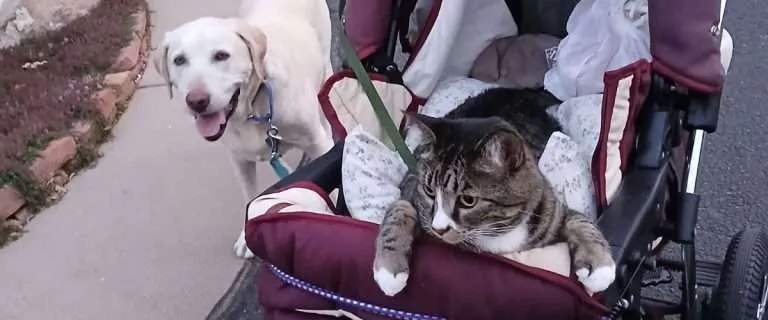
Thirty million pets in America live in homes where the humans are deciding between dinner and dog food. Colorado Pet Pantry feeds 125,000 animals a year. Almost nobody knows the crisis has a name.
By Emily Bernard
Boulder Weekly
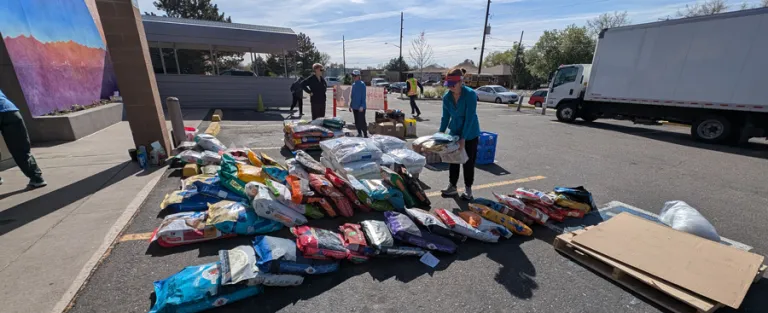
Every month, in more than 100 parking lots across Colorado, volunteers in matching blue shirts unfold tables. They stack bags of kibble into leaning towers and slide cans of cat food into neat rows. Car doors open. People make their way toward the awning-covered tables.
Their pets wait hungrily at home. The line grows.
Pet food insecurity exists in a space public assistance and charitable giving often miss. SNAP doesn't cover kibble. Food banks hand out rice and beans, not cans of cat food.
Colorado Pet Pantry was built for that gap. In 2013, founder and executive director Eileen Lambert heard about a pet food bank in Atlanta on the radio and wondered why Colorado didn't have one. Today, CPP operates more than 100 distribution sites across 38 Colorado counties.
What's at stake in that line is more than a bag of kibble.
THE STORY LAMBERT KEEPS TELLING
Groceries cost more. Gas costs more. A household that was fine a year ago is scrambling to cut corners at the kitchen table late into the night.
On top of that, pet food costs have climbed more than 23% above pre-pandemic levels. The industry calls it petflation. In Colorado, that number lands hard. Roughly 18% of pet owners told researchers at Colorado State University's Animal-Human Policy Center they had struggled to get food for their pets in the past two years. Most said the same thing: it was simply too expensive.
"A bag that used to be $60 is now $100," Lambert says.
Nationally, 30 million pets live in homes managing food insecurity. PetSmart Charities found 83% of pet parents experiencing food insecurity would feed their pets before themselves.
"Every single day," Lambert says. "That's the most common thing we hear from people, is that they would feed their pet before they feed themselves."
Asked what moment stays with her, Lambert doesn't cite pantry totals or expansion plans. She talks about a woman she met at Broomfield FISH.
She's 70. In a single year, she lost her son and her job. She lives with PTSD and memory problems in a house she can no longer afford. Her cats are her family now, but even keeping food in their bowls has become difficult. At night they sleep on her chest, staying when almost everything else has left.
This is why CPP does not verify hardship. No pay stubs. No paperwork. No one asking people to explain themselves.
"Judgment has no place in why a client is at our pantry seeking food," Lambert says.
"Each of us is a lot closer to needing support than we are willing to admit," says Karen Collins, CPP's director of philanthropy and partnerships. The goal is to reach people while their animal is still in the home. Before a run of bad luck turns into a surrender.
That surrender is not hypothetical. Denver Animal Shelter took in 2,810 pets from their owners in 2025, more than eight a day and a 236% increase since 2020. For the 70-year-old woman Lambert remembers, surrendering the cats who meet her at the door would not solve the problems that brought her to the pantry. It would add another loss.
"The fear of losing a pet, which data shows is one of the number one support systems for mental health, to have to give up a pet because of an acute economic hardship would be really traumatizing," Collins says.
The pet is human need, wearing fur.
HOW THE TABLES GET THERE
The pantry doesn't build its own lines. It finds lines that already exist.
Every CPP distribution is hosted by a nonprofit already serving people in need, putting pet food where people are already coming for help. In Boulder, that means EFAA on the fourth Thursday of each month, where families receive a month's worth of pet food. At Harvest of Hope, CPP hands over the kibble and volunteers repackage it into smaller bundles. Some guests are carrying everything they own in a backpack.
Then there are the rural hubs: Trinidad. Alamosa. Grand Junction.
In rural Colorado, where resources are thin, a pantry can become a destination, sometimes the only place offering both human food and pet food. People spend half a day getting there. Bringing home both from one trip is the difference between a hard day and an impossible one.
Sometimes they still leave empty-handed.
"We try really hard not to run out of food," Lambert says, "but it all depends on the size of the vehicle that we have and the amount of food that we have available."
"I would love to have 200 pantries," she continued. "But I want to make sure we're agreeing to things we can achieve."
Which means sometimes the van is empty and the line is not.
THE BLIND SPOT
"People often forget that we are supporting the underserved," Collins says.
When a corporate partner says its philanthropy focuses on education or economic mobility, Collins argues pet food belongs in that conversation. If a family is choosing between the dog's dinner and the electric bill, "the whole household is wobbling."
CPP's giving extends beyond pet parents in line. Through its Animal Welfare SHARE program, 107 rescues, shelters and animal control agencies have round-the-clock access to CPP's warehouse. They pull what they need when they need it instead of filling kennels or storerooms with supplies they cannot use.
"Something that not many people know is that we're all working together and we're all supporting each other," Collins says.
Some of that need arrives without warning. After the Marshall Fire, CPP set up at the Disaster Assistance Center in Lafayette and learned people didn't need kibble as much as they needed the things you leave behind when you run: beds, leashes and carriers. The organization distributed 2,000 dog beds in two weeks. A call for supplies filled Lambert's driveway with Amazon boxes. That response eventually became a partnership with the American Red Cross, which now distributes pet comfort kits during disasters.
The need for that kind of readiness didn't end with the Marshall Fire. For the second year in a row, floodwaters in Pagosa Springs washed out roads and forced evacuations across Archuleta County. The Colorado National Guard rescued more than 40 people and 16 dogs. Small animals were sheltered at the Humane Society on Cloman Boulevard. Horses went to the county fairgrounds. For many evacuees, what happens next depends on whether there is a safe place for both them and their pets.
CPP's comfort kits were designed to bring a sense of security: a bag with a collar, a leash, food and a toy, things that make pets feel at home in time of upheaval.
THE $5 BAG AND THE VAN THAT CARRIES IT
All of the pet food CPP hands out is donated.
Most of it never reaches a store shelf. It's the bags a week from their best-by date, still perfectly good and suddenly unsellable. Collins estimates about 70% comes from manufacturers and distributors with product they'd otherwise pay to dispose of. The rest comes neighbors. The bag of food your cat turned her nose up at. The bed and bowls left behind when a pet crosses the rainbow bridge.
"It's two problems solving each other," she says.
Instead of paying to throw it away, companies receive a tax deduction and the supplies reach pets that need it. But big companies only send what they make. The person clearing out a cupboard sends variety, and variety is what saves a dog who can't eat what everyone else can.
"There is chicken in absolutely everything for a dog and a cat," Lambert says. In someone's cupboard is the allergen-friendly food pets like this need.
Cash works differently.
It doesn't buy supplies. It moves them from warehouse shelves to pantry tables to pets' bowls. For years, CPP has said $5 feeds a pet for a month. That's still true, Collins says. But support now extends beyond food to collars, leashes and beds. Meeting a pet's essential needs is closer to $10 a month.
"Because we've had so many people, that's why we've been able to be across the state and help so many pets," Lambert says expressing gratitude. Last year they logged nearly 26,000 hours sorting kibble, staffing distribution tables and emptying donation bins.
Food still has to move. Volunteers can't haul a thousand pounds of kibble in their cars. This spring, CPP replaced its aging fleet of vans through a campaign called Fund a Fleet. One donor called to say she'd been about to buy herself a new car, but hers was fine. She would rather CPP buy one instead.
Her gift covered an entire van.
The new Denver van holds 4,100 pounds, up from 3,100.
An extra pallet at every stop.
THE DOG WAITING AT THE DOOR
What's at stake in that line isn't really the pet food. It's whether the animal stays.
To Lambert, that comes down to a simpler question than most nonprofits would ask.
"Did we get pet food to people who need it?" she says. "The only time we fail is if we didn't get pet food to people who need it. Everything else is just paperwork."
Every month, in more than 100 parking lots across Colorado, volunteers fold up the tables and load empty bins back into the vans. The cars pull away one by one. Somewhere in Colorado, a pet parent goes home with a month's worth of food.
Somewhere else, a dog or cat is still waiting for dinner.
To donate, volunteer or host a food drive, visit coloradopetpantry.org.
If you're the one deciding between dinner and pet food this month, search for a pantry near you on CPP's website.
Colorado Gives Day is Dec. 8, and the Colorado Gives campaign runs Nov. 1 through Dec. 8. Every gift made during that window helps CPP claim a share of a $1 million incentive fund. The Colorado Gives Foundation is also matching the first month of new recurring gifts through a $250,000 pool. CPP's fundraising goal is $250,000, about a quarter of its annual budget.