

In a political climate increasingly hostile to diversity, equity and inclusion, many artists of color are watching opportunities vanish before their eyes.
“I’ve had two projects canceled already this year,” says Denver-based visual artist Sammy Lee. “It feels like we’re in a different time. With this whole crusade against DEI, it’s like you have to pluck out any words related to identity to get support.”
That’s why Lee — and many others — weren’t sure the Dairy Arts Center’s Go West exhibition would happen. “I actually thought that this show would be canceled,” Lee says. “I contacted Stella Witcher [the Dairy’s visual arts curator] and asked, ‘Is this on?’ I was told the Dairy is very committed to this show, which was very refreshing in this political moment.”
Running May 16 through June 29 in the McMahon Gallery, the show features work by 12 Asian American artists whose practices reflect on identity, diaspora and the enduring myth of the American West.
Organized under the guidance of jurors Rajiv Menon and Roseline Neveling, and curated locally by Witcher, Go West invites audiences to reconsider whose stories the West has traditionally centered — and whose have been left out.
“The exhibit explores the legacy of the American West and how it has always had this kind of romanticized view through the lens of fiction and mythology,” Witcher says. “The purpose of this exhibition is to 1.) acknowledge that the past has been romanticized, and 2.) point out that it is often whitewashed in some way and doesn’t reflect the true legacy of the American West, which is one of diverse communities coming together from all over the world to make this place home.”
Reclaiming the West
Rather than reinforcing familiar images of cowboys or conquest, Go West aims to reframe the frontier as a site of convergence. The resulting exhibition spans a range of materials and scales: large hanging tapestries, tiny 3D-printed objects, textile installations, paintings and intricately layered works on paper, all filtering the Western mythos through a diverse lens.
Lee, a Korean-born artist who moved to Southern California as a teen and now resides in Denver, is exhibiting A Very Proper Table Setting, a collection of 40 cast-paper table arrangements based on true stories from Denver communities. Each was created through public participation pop-ups, in which Lee invited strangers to cook a meal for a loved one.
“This is my way to use food, dining culture and table settings to talk about many layers of different human relationships,” Lee says. “This is a very American project because I am using dinnerware from my heritage almost as a container for other people’s culture.”

Another contributor, Arvada-based artist Bala Thiagarajan, explores layered identity using a more symbolic visual language. A former biologist originally from Chennai, India, she blends South Indian decorative traditions like rangoli with Western landscapes in her richly textured paintings and ceramics. For Go West, she created new works featuring jagged Colorado peaks, autumn aspens and South Asian women.
“When you’re in a new place, in a different place, even though there’s a sense of belonging here, you also want to hold on to what was,” Thiagarajan says. “This show is more about the story of migration. All the artists are first-generation immigrants or second-generation immigrants, so it’s not just physical movement. The show is also about this transformation of who you are, what your identity is and questions of how you bring your culture into your art.”
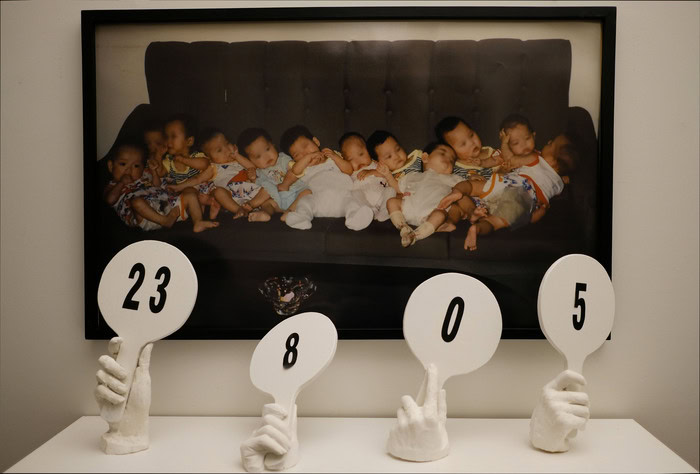
Other works in the show push the theme even further afield. Maki Teshima incorporates native Colorado plant dyes into Japanese textiles to explore ecological belonging. Mattie Hanson critiques the transnational adoption industry, weaving together economics, personal identity and state policy. The variety of media and approaches wasn’t accidental.
“We wanted to reflect the diversity of art that Asian American artists are making in Colorado and the West,” Witcher says. “All the pieces in the exhibition really speak to the complexity of Go West and all of the expected and unexpected ways this theme ties into every aspect of living in Colorado and in the West. Not just for these artists and for Asian Americans, but for all of us.”
Art in a climate of erasure
The Dairy has planned several public programs to extend the exhibit’s themes beyond the gallery walls. The opening night reception on May 16 features a performance by Indian classical-fusion artist and Naropa professor Sheela Bringi. A June 10 artist talk moderated by Melissa Utomo of Boulder’s Community Roots Art Festival will feature panelists reflecting on their creative process, and an unannounced, on-theme film will screen June 23.
But even with support from the Dairy, there’s an undercurrent of urgency for artists like Lee. “There’s still part of me wondering if this will be the last year for this show,” she says. “Could something like this happen next year?”
Since the Dairy doesn’t rely on support from sources like the National Endowment for the Arts, the center isn’t at risk of losing funding in the current climate — but as the rightward lurch of the federal government generates a chilling effect across cultural institutions nationwide, Witcher says they’re committed to bringing art like Lee’s to Boulder audiences for the foreseeable future.
“We’re hearing from artists that their projects are drying up. That’s erasure,” she says. “We are not going to shy away from discussing diverse topics and allowing people to share their lived experiences through their art. … Freedom of expression is more important now than ever, and that’s something the Dairy’s not negotiating.”
With few platforms already available for AAPI artists in Colorado, the show’s existence feels both necessary and tenuous.
“There are not a lot of events happening specifically for Asian artists,” Thiagarajan says. “We are a small group. We’re not going to be in every single space, but if we can be in one or two more each year, spaces where you know there is some light on us, that we exist, that will help inspire kids and others to value culture.”
ON VIEW: Go West: Celebrating AAPI artists in the American West. May 16 through June 29, Dairy Arts Center, 2590 Walnut St., Boulder. Free