

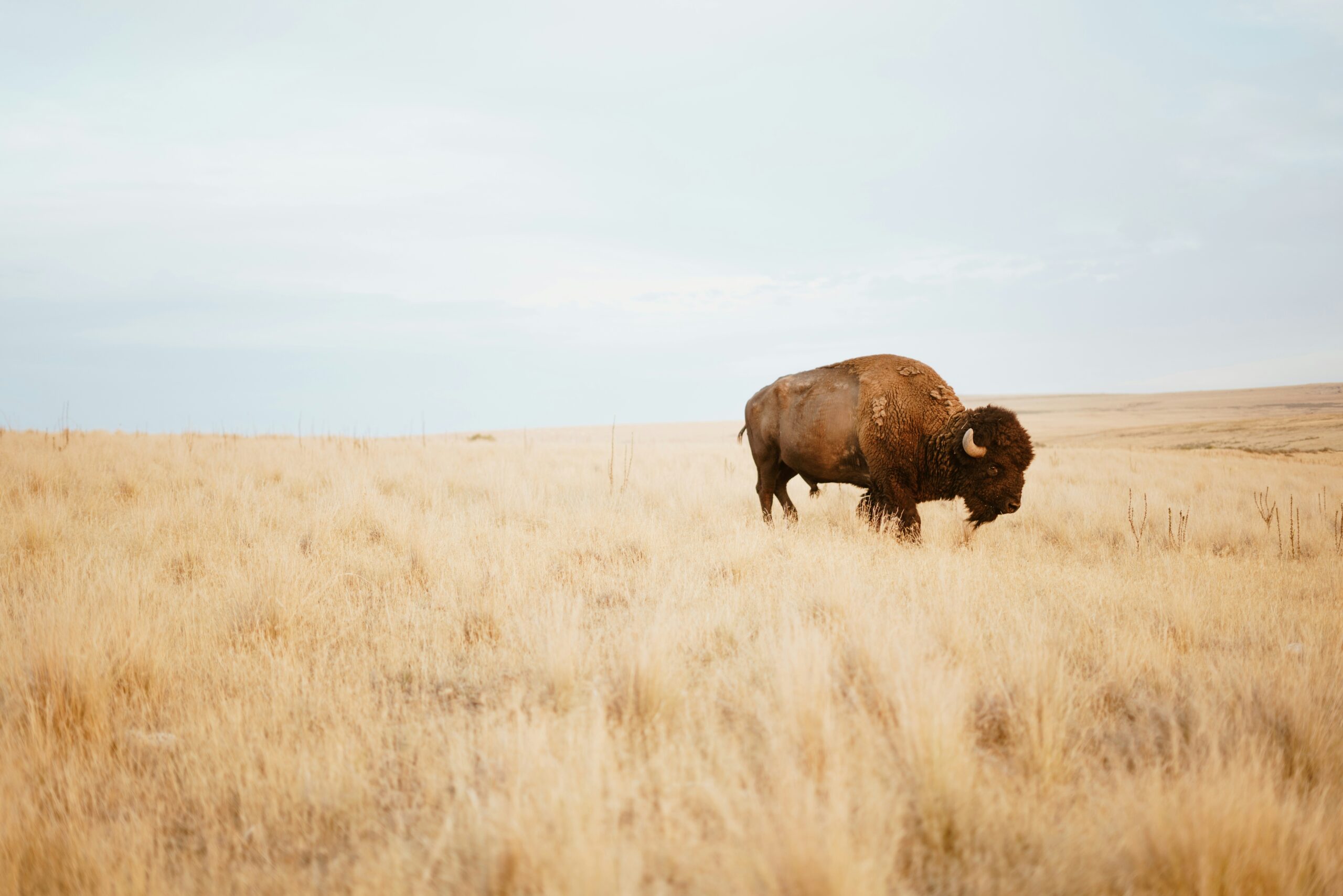
Are you a CU Buffs fan? Did you know our national mammal and favorite mascot (Ralphie!) was brought back from the brink of extinction? How much do you know about the animal we call buffalo (but is actually the American bison)?
While Ralphie is the only bison on a football field, there are now over 20,000 bison in conservation herds around the country. But much work remains to ensure the viability of their original range, the Great Plains of North America.
Bison are an important keystone species, meaning they shape the ecosystem around them, and are imperative for restoring grasslands. Without the continued progress of bison reintroduction to Tribal and public lands, America’s grasslands hang in the balance.
Funding cuts and oil and gas expansion under the Trump administration threaten this progress.
If you had visited Colorado’s Front Range grasslands prior to European settler expansion in the mid 1800s, you would have seen thousands of bison moving across the land with a total population of up to 60 million on the continent. Grasslands once covered a third of North America with an estimated 4% of the original biome remaining today.
Despite their shrinking size, the Great Plains are a hotbed for biodiversity with over 500 species of native plants, mammals, birds and insects. Prairies are also a carbon vault, storing as much carbon below the ground as forests can store above ground, with grass roots penetrating 8-15 feet into the soil. These roots can bury carbon deep underground for decades, sinking the equivalent of 11 homes’ annual energy usage (22.5 tons of carbon) in each acre.
What was once undisturbed prairie covering 170 million acres is now small, fractured pieces of land fenced off for cropland expansion, residential and commercial development and energy extraction. Invasive species and increased temperature extremes also threaten this valuable landscape.
Returning bison to their native lands provides a solution to restoring this degraded ecosystem. As ecological researcher Alan K. Knapp explained in a landmark 1999 paper, it is easy to see that the plains and bison evolved together. When bison roll on the ground, they create depressions known as wallows that fill with rainwater and sustain all life in the dry prairie. They selectively graze, minimizing invasive grass species, and their hooves help seeds germinate. Rebalancing the ecosystem in this way is essential for the future of grassland conservation and has direct benefits for people as well.
The North American grasslands and bison evolved with the Plains Tribal Nations. There is a reciprocal relationship between these Indigenous peoples, bison and the land, with each a careful steward of the other.
Lindsey Schneider, a Turtle Mountain Chippewa descendent, explains in a 2022 article that Indigenous people are not only integral to the restoration of bison on grasslands, but should be restored to their homelands in the same way as the buffalo. When bison and Indigenous people are decoupled, neither thrive as they do when together.
Acknowledging the importance of Tribal stewardship of public lands and bison reintroduction to grassland conservation has picked up speed over the last few years. In 2023, the U.S. Department of the Interior announced a new Secretary’s Order to restore bison populations and the prairie grasslands “through collaboration among partners such as federal agencies, states, Tribes and landowners using the best available science and Indigenous Knowledge.” Over $25 million was invested toward this order.
Under the new administration, Tribal wellbeing, the survival of bison and the health of grassland ecosystems are all on the chopping block. The newly appointed Interior Secretary, Doug Burgum, has said he supports Tribal communities, but on his first day in office signed six executive orders to expand oil and gas development on public lands, including grasslands. In less than three months, Trump has already cut millions of dollars in federal funding for Native American nonprofits that are often the only assistance these communities see, including those that fund bison conservation.
With over 26 million acres of public land already available for energy production, it makes no sense to expand drilling. These lands are cherished outdoor spaces that sustain rural economies, ranchers, generations of hunters, outdoor recreators, healthy wildlife ecosystems and, increasingly, the bison.
In the state of Colorado, bison are “livestock,” unable to roam free like elk or pronghorn. Returning bison to their original range on the Great Plains will require landscape-scale, transboundary cooperation between Tribal Nations, private landowners and multiple levels of government across public lands, ancestral lands and private property.
Until Tribal Nations gain back sovereignty and their ancestral lands, bison will not be fully home either. Please consider donating to the Intertribal Buffalo Council or Tanka Fund to support the restoration of buffalo on Tribal lands, and contact your state and federal representatives in defense of our public lands.
Together, we can support our Buffs and bring home the American bison!
Sarah Kosling is a graduate student at Colorado State University in the Department of Human Dimensions of Natural Resources. She loves climbing rocks, planting things and sunset hikes. She hopes to contribute her energy toward the fight for North American grasslands long into the future.