

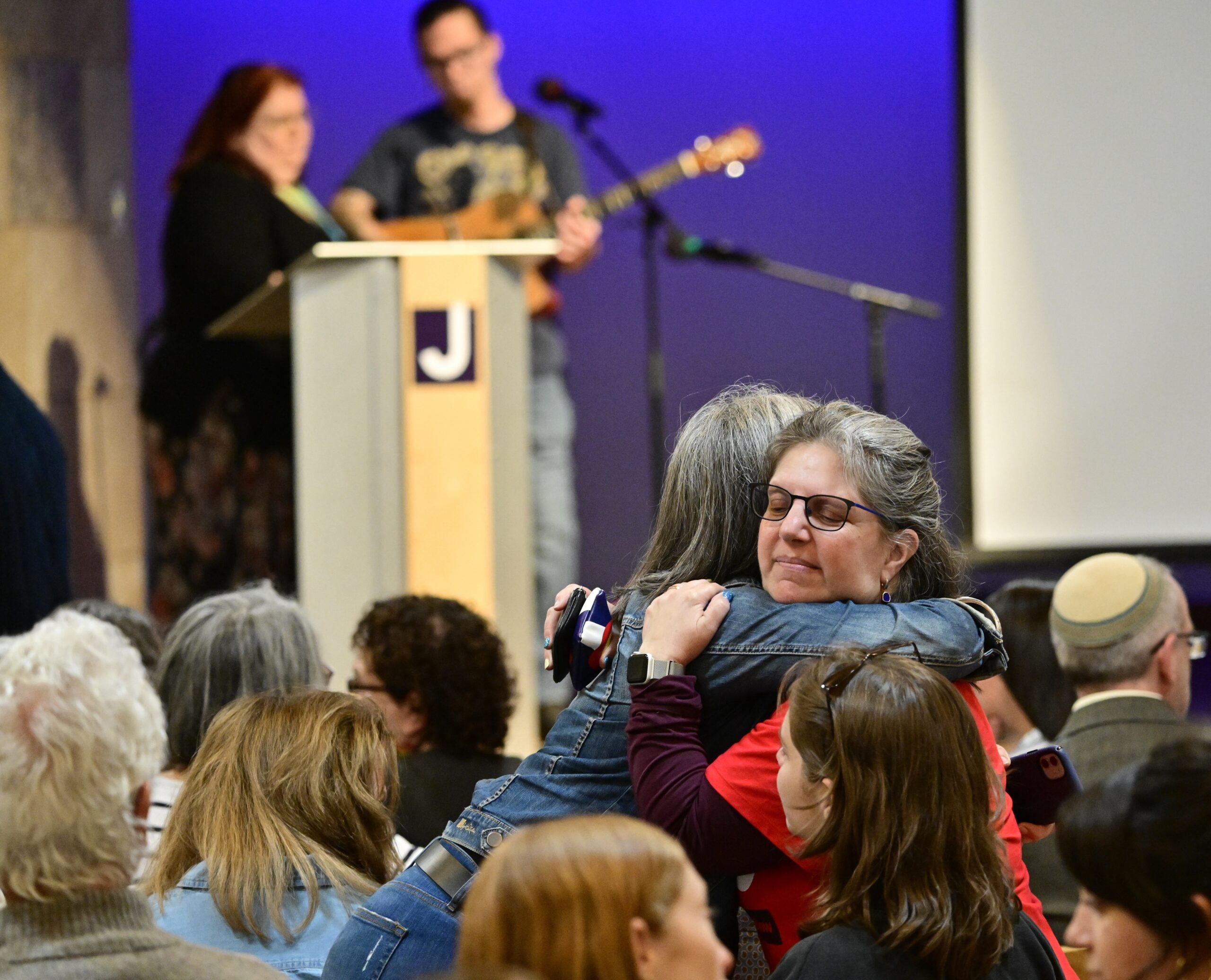
“The thing is, life continues,” said Ruth Gelfarb, rabbi at Boulder’s Congregation Har Hashem.
And so it has. Mere weeks after a man threw Molotov cocktails at a crowd of people on Pearl Street Mall’s central block, life has settled back into its old rhythms for most Boulderites.
The Boulder County Courthouse opened two days after the June 1 attack on the building’s doorstep. Businesses say customers and crowds have come back. The demonstrators who were targeted have held two regularly scheduled walks advocating for the release of Israeli hostages taken by Hamas on Oct. 7, 2023.
But for the local Jewish community, the return to normalcy has been punctuated by varied and turbulent feelings, say Gelfarb and other leaders.
“Pain, fear, resilience, pride — everyone is in a different place, and every day a different emotion comes up for people,” said Jonathan Lev, executive director of the Boulder Jewish Community Center (JCC).
Moving forward
“Many more people” have come to Har Hashem’s religious services since June 1, according to Gelfarb. A similar surge in attendance happened at her New York synagogue after Sept. 11, 2001, she said, as the community rallied to grieve and comfort one another.
“Not to be alone in your pain is so important,” Gelfarb said. “No one can heal themselves alone.”
CU Hillel, the campus center for Jewish life, has spent the last two weeks reaching out to members of the student Jewish community and their families.
“The first thing I noticed was an outpouring of support, which was heartwarming to feel,” said Executive Director Elyana Funk. “I haven’t had a lot of parents reaching out and being worried… It’s been more like ‘What can we do to support? How are you moving forward as a community?’”
The Boulder Jewish Festival, held one week after the violence, was the best-attended ever, Lev said, drawing an estimated 15,000. Thousands marched with Run for Their Lives in the group’s first public event following the attack on its members, held during the Jewish Festival.
Lindsay Shaw, owner of Lindsay's Boulder Deli, who is Jewish, attended the festival and said she’s also felt an outpouring of support. She is trying to balance those feelings of community solidarity with her ongoing fears and the responsibility she feels to rise above them.
“I can’t be scared of it. I started to get scared [at the festival], but then I was like, I’m letting them win,’ so I can’t even think about it that much,” she said. “I’m trying to serve good food in a clean environment and have great customer service. That’s what I’m trying to do. I’m not trying to worry about who’s gonna walk in the door or what’s someone gonna do now on the mall.”
Safe spaces
In the days following June 1, Boulder Police initially made “some changes to scheduling for our patrol officers to provide more coverage on the streets and in our communities,” said Boulder Police Deputy Chief of Operations Barry Hartkopp. At the Jewish Festival, SWAT teams were on the streets and snipers were on the roofs.
Police presence in the community has “since reduced that back down to a normal response, normal scheduling,” Hartkopp said, “but we still are planning ahead, trying to up staff where we can.”
“We are looking at all the events that are planned for the City of Boulder and evaluating them based upon information that we have, and taking steps to try to keep those events as safe as possible within our capability.”
The 2023 Hamas attack and Israel’s subsequent military campaign in Gaza have heightened threats to Jewish, Arab and Muslim people in Colorado. As of June 11, 2025, more than 1,200 Israelis and 55,104 Palestinians have been killed, according to the United Nations Office for the Coordination of Humanitarian Affairs.
In 2024, 47 anti-Jewish hate crimes were reported in Colorado, according to the Colorado Bureau of Investigation — nearly triple the average number reported annually since 2008. In 2023, reported anti-Arab and anti-Muslim hate crimes spiked to 15, about half of which occurred after Oct. 7, though there’s no data linking the crimes as a response to the event.
This data only represents reported incidents. The 2021 National Crime Victimization Survey revealed 42% of hate crimes from 2005-2019 went unreported; 23% of victims said they didn’t report the crime because they believed the police could not or would not do anything to help.
Hartkopp said police “have not received any specific requests for enhanced security,” from the Muslim community, “nor are we aware of any reported threats to this community.”
The Islamic Center of Boulder and the CU Muslim Student Association did not respond to requests for comment.
“LGBTQ, Muslim community, the Jewish community — any community in our city is important to us,” Hartkopp said. “It’s really critical that we ensure that all of our community members feel that they’re safe and they have the right to to have gatherings and to express themselves.”
He said he was not aware of additional incidents or threats “tied directly” to the Pearl Street attack. “But what we’re seeing really is that concern and the fear in our community based upon what did take place.”
CU Hillel’s Funk said the organization was “already working on security enhancements” before the June 1 attack, but the violence only made it more important to the organization.
“I don’t know what the year will look like,” she said. “We will continue to provide safe spaces where Jews can come together and build community.”
‘It’s heavy right now’
Amid rising tensions, CU Hillel recognized a need for mental health support for Jewish students on campus. In May, the organization began the application process for a grant to hire a wellness director, according to Funk.
“People are not OK, and students are not immune to that,” she said. “It’s heavy right now, obviously with this attack, but also the war and October 7, changed our Jewish community forever. So we are needing extra mental health support here, too.”
Denver nonprofit Jewish Family Services is providing one-on-one and group counseling sessions free of charge. Community Foundation of Boulder County and Denver-based Rose Community Foundation provided funding.
Lev and Gelfarb both recommended reaching out directly to Jewish friends and neighbors — to check in, offer a meal or share some small act of kindness — and to keep doing so far into the future.
“It really makes a difference when people reach out and send the love and send the support to people in the Jewish community,” Lev said. “That’s not just the week after, that’s next month.”
“People move on,” Gelfarb said, “but healing takes time.”
Kaylee Harter, Tyler Hickman and Shay Castle contributed reporting.